UT Astronomer Selected for Frontiers of Research Project
Philanthropic support from the Simons Foundation is expanding opportunities for discovery on Earth and beyond.

Transformative philanthropic support secured during the What Starts Here fundraising campaign extends the impact of Texas Science beyond the Forty Acres, providing researchers and students with resources to explore the farthest reaches of the cosmos.
Caroline Morley, associate professor of astronomy at The University of Texas at Austin, and her research team recently were among a dozen groups worldwide selected by the Simons Foundation, a philanthropic organization that supports research in mathematics and the basic sciences, for support. The project will involve studying multiscale physics of clouds across the atmospheres of planets beyond Earth. By examining clouds on a wide range of planets outside the solar system, called exoplanets, and exploring physics in extreme environments, Morley and her team hope to deepen understanding of fundamental atmospheric processes and apply those insights to improve climate science on Earth.
“We started this project at a Simons Symposium, where we started to talk to each other across disciplines and realized that clouds are the biggest problem in predicting how Earth is actually changing in its climate overtime,” Morley said.
Morley, who directs the project, noted that even small differences in how clouds are represented in climate models, including their altitude and their ability to reflect or trap energy, can significantly alter predictions about Earth’s future climate.
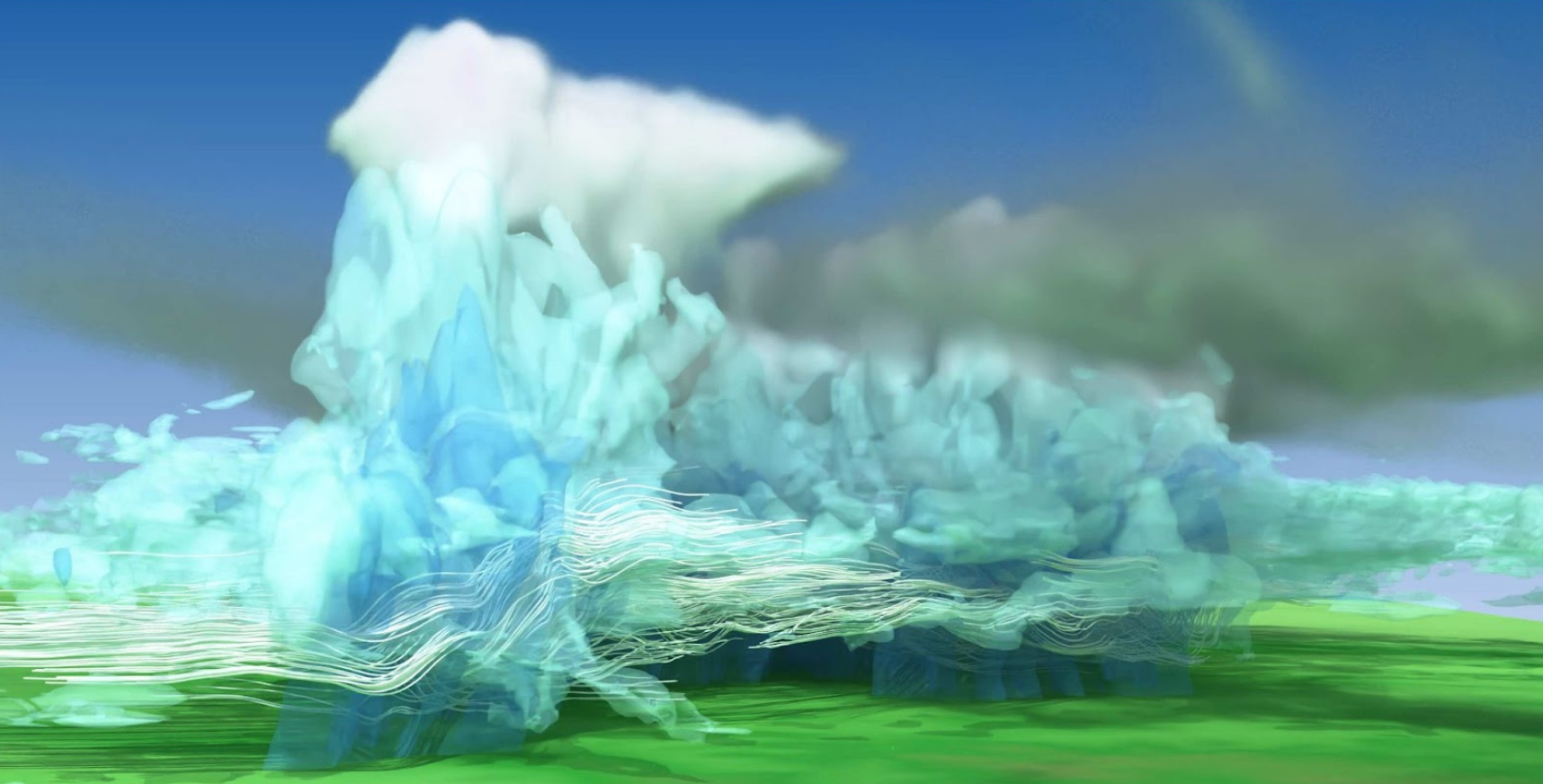
Visualization showing a snapshot of a simulated storm cloud in an ICON simulation at ~150m resolution. Cloud ice is shown by volume rendering (white/grey puffy cloud), while cloud water (bright blue) and rainwater (blue) are shown as isosurfaces. Streamlines seeded in areas with rain water at a height of ~1 km additionally show the complex flow patterns. Courtesy: HD(CP)2 project, Max Planck Institute for Meteorology.
Morley said her team’s theoretical studies and simulations of planets will help researchers determine what to look for with the Giant Magellan Telescope and make sense of the observations it captures. (UT is a part of an international consortium of universities whose collective investments in what will be the world’s largest ground-based telescope, the GMT, amount to about $1 billion.) Her project will also utilize observations from the James Webb Space Telescope.
“Really, UT is a place where innovation is happening across the board – for the observations, the theory and the instrumentation,” she said. “That’s really unique. Not that many places in the country offer that – you could list them probably on one hand the number of places that have all three of those things at once.”
Morley said the Simons project team’s approach brings together researchers who rarely collaborate in traditional scientific settings, including Earth climate scientists, planetary scientists and astrophysicists. By drawing on diverse expertise and data sets, researchers can approach shared questions from new perspectives and generate innovative solutions.
“This kind of philanthropy really allows us to spend time being creative, talking to people we wouldn’t normally talk to, and it’s in those conversations when the sparks that lead to new ideas happen,” she said.
Morley will work with a team composed of researchers from across Europe and the U.S, including experts from UCLA, the University of Maryland, the University of Chicago and the Geophysical Fluid Dynamics Laboratory in New Jersey, as well as Oxford University in England, Leiden University in the Netherlands and the Max Planck Institutes for Meteorology and Astronomy in Germany.
The core research team will consist of nine principal investigators, eight postdoctoral researchers and at least two graduate students. Morley also hopes to involve undergraduate Longhorns in some of the research.
“For me, when I was promoted a couple years ago to associate, I started thinking about ways that I could expand and come up with some bigger picture ideas and also things that might both matter for exoplanets and also to people here on Earth – the Earth that we live in,” Morley said. “So, I’m really excited that this resonated with the Simons Foundation.”
Morley’s team is one of 12 groups across the United States funded as Targeted Simons Research Groups by $3 million grants from Simons Foundation International administered by the Simons Foundation. These three-year collaborative projects explore fundamental questions in math and physics topics ranging from dark matter to strange metals to how geometry and physics shape life. Other participating institutions include the Massachusetts Institute of Technology, Harvard University and Purdue University.
The new transformative grant is the most recent in a line of philanthropic support for the Department of Astronomy, advancing work that starts here on Earth and changes how researchers understand the universe.
In 2024, the Simons Foundation helped establish the National Science Foundation-Simons AI Institute for Cosmic Origins at UT led by another UT astronomy professor, Stella Offner. The foundation provided $10 million for the grant, and the NSF provided $10 million. Offner, director of the institute, is also co-director of the Center for Scientific Machine Learning at UT.
Through the What Starts Here campaign, donors have helped create new opportunities for Texas Science and UT Astronomy in recent years. Generous gifts from David Booth and the Winn Family Foundation helped bolster construction of the GMT in Chile’s Atacama Desert, which will be the world’s largest telescope when completed.
Booth contributed $10 million toward McDonald Observatory’s share of construction costs for the GMT, with the observatory dedicating the David G. Booth Director’s House in 2023 in his honor. The Winn Family Foundation, which also supports the Texas Field Station Network of which the observatory is a part, contributed support to the creation of the GMT, which is the largest-ever private investment in ground-based astronomy.